Passing the Budget Used to Be Tuesday. Now It's Content
On the administrators narrating the job, the coaches mythologizing it, and the residents scrolling past both.
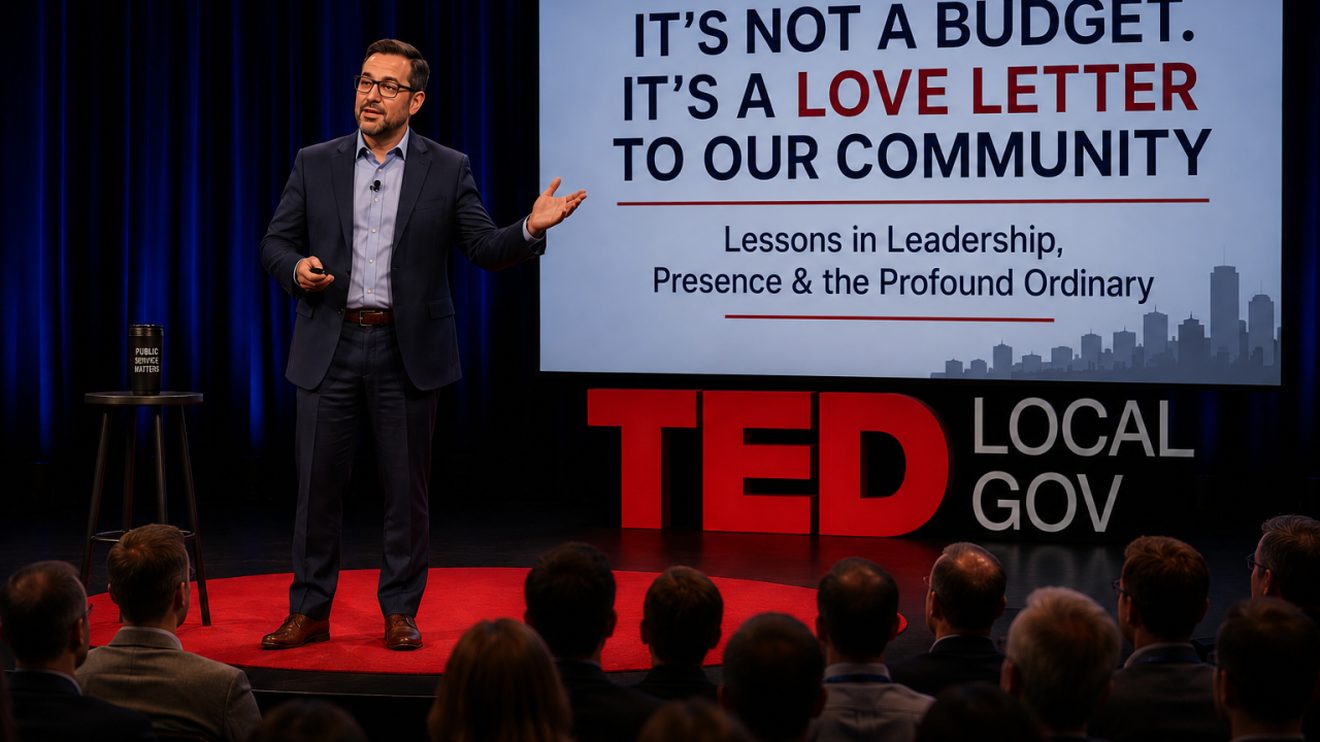
While the concept for this article has been ruminating in my head for some time, I was on a plane when I came up with the introduction. As the pilot landed, I thought to myself, what if the pilot came over the intercom and said:
Folks, we've just touched down. And I'll be honest, my first thought was not what you'd expect. I didn't think about the runway. I thought about trust. Because a landing isn't a maneuver. It's a promise. And the wheels didn't just touch the ground. They touched the community. Agree?
I'd probably try to make sure I never flew that airline again, or at minimum, try to figure out that pilot's schedule to avoid him. The landing was smooth, but I'd be very concerned about anyone who needed me to not only witness them doing their job but announcing what is such a routine part of it as if it were a TED talk.
That hypothetical intercom speech is the spoken-out-loud version of my LinkedIn feed. Somewhere on there right now, a city manager or administrator is announcing that their council passed a budget. It's not a historic budget and it didn't close a generational deficit or fund a once-in-a-century project. It was just the same annual budget, due at the same time it has been year after year, assembled by a finance director who will make an appearance in the post as part of "my incredible team."
For someone with a large network, the post might get a few thousand impressions, which sounds impressive until you learn the metric counts anyone whose screen showed half the post for a third of a second. In other words: people scrolling past it. It might get a hundred or so reactions; some will undoubtedly come from leadership coaches, who will comment "This! 👏" before returning to their own content: an infographic, perhaps, mapping the 14 invisible burdens inside the brain of a city manager, with a call to action at the bottom.
I really do enjoy this profession and have much admiration for the professional colleagues I've met across the country and internationally throughout my time in it. But if you've made it this far, you should know, I am going to complain about it a little bit.
My complaint is twofold, and the two are intertwined. The first is the narration: Administrators repackaging routine job functions like passing budgets, paving roads, and maintaining infrastructure as transformational personal triumphs, with lessons learned and calls to engage. The second is the inflation: a growing number of consultants, vendors, and even CAOs attempting to rebrand the role of City Manager as uniquely difficult and one that no one can possibly understand without us constantly announcing it. So, one genre performs the profession; the other mythologizes it.
You've Seen These Posts Before
The pilot's speech follows a formula I didn't invent for this article. It follows what is often referred to as the Contrarian Revelation, a highly effective LinkedIn post structure: states a basic fact, challenges a widely held belief, puts forth a revelation, and asks for engagement. Here's a specimen in its natural habitat: the routine job function dressed up as a transformational moment.
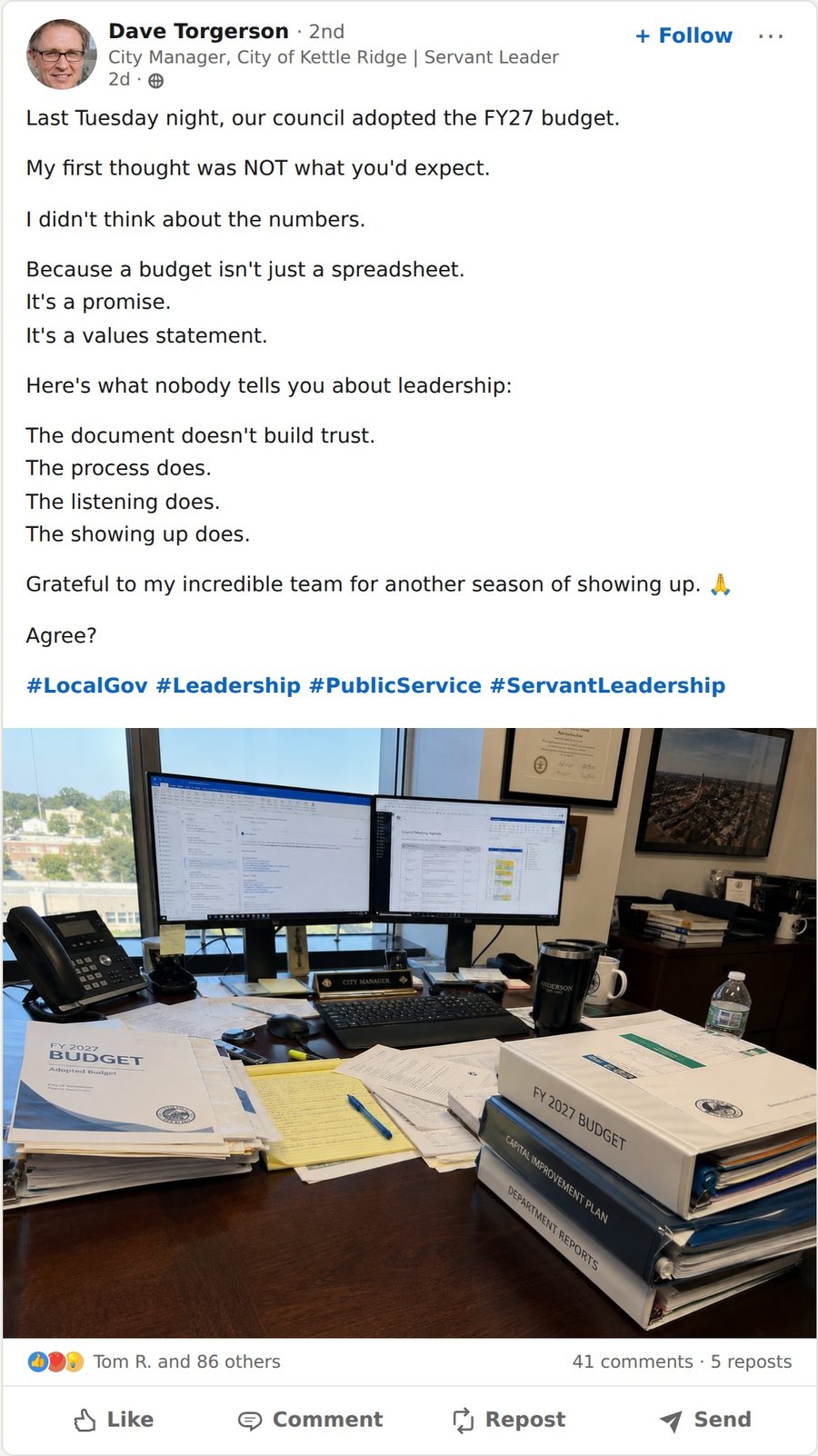
Note the plot twist: his first thought was NOT what you'd expect. It never is. It never, ever is what you'd expect.
Here's the thing. The idea that the budget reflects the values and priorities of the community is not a revelation worthy of a TED talk. It's the first thing taught on the first day of any budgeting class in an MPA program. How the document presents those values is a criterion for the annual GFOA budget award.
The narration has a sibling, usually written by someone selling something. This one frames the profession as a heroic burden. This litany is 14 items, because 12 wouldn't convey the crushing totality of it. Every sentence gets its own paragraph, because that is how you know each one is profound. And it closes with a heart emoji, the genre's official punctuation.
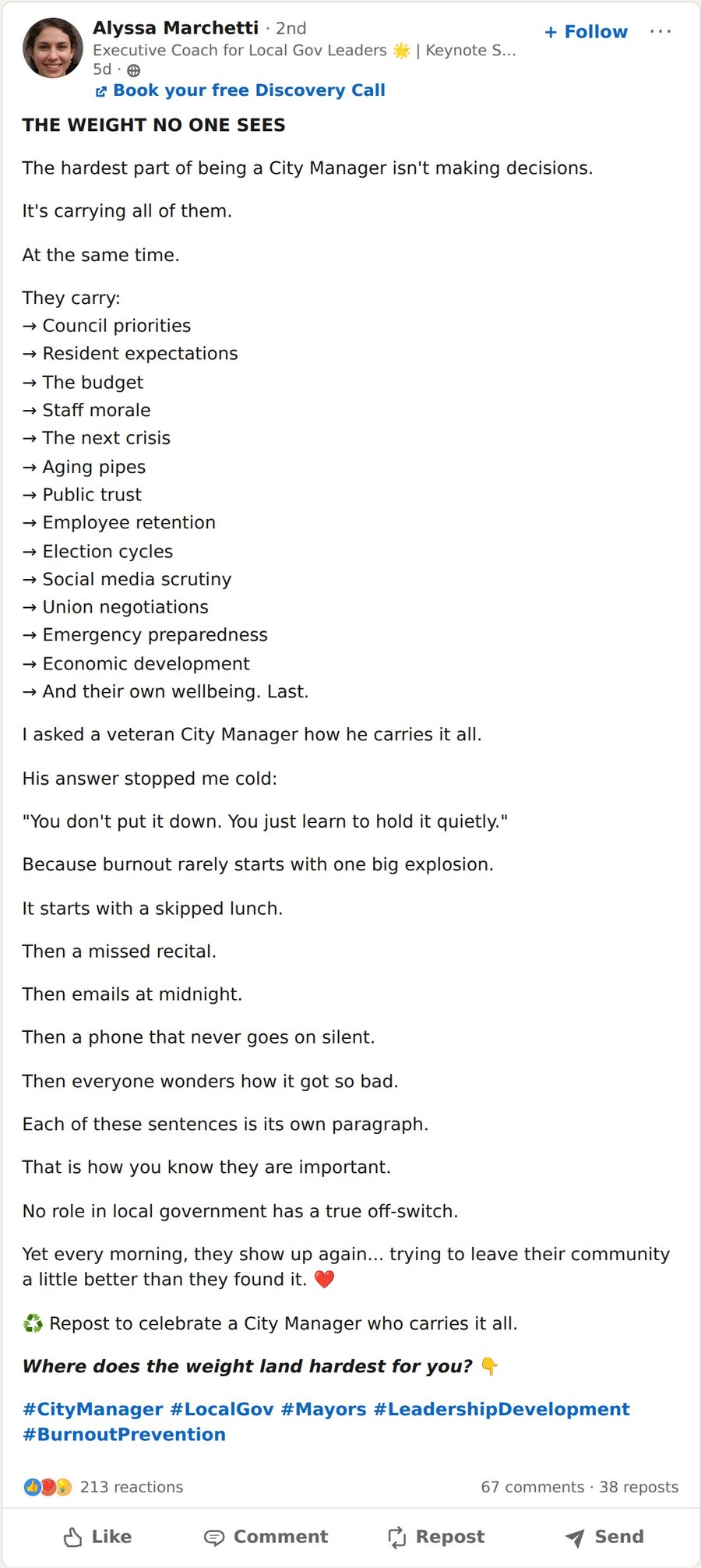
Notice the difference between the two formats. The Contrarian Revelation is sung by managers about themselves. The Burden Ballad is usually sung to managers by the people selling to them, with a booking link in the bio, though sometimes managers sing it themselves. To be clear, there is nothing wrong with a consultant advertising services to the profession; that's business. It becomes problematic when the promotion is disguised as introspection.
We've Started Narrating the Job Instead of Doing It
I've been in the profession long enough to remember when passing a budget wasn't content, it was Tuesday. You passed the budget, then implemented it. The road got paved, and people were happy to drive on it. And a park got built or refurbished, and kids played on it. While the Mayor and City Council often would cut a ribbon or brag to the press, which is literally part of their jobs, very few saw a City Manager's name anywhere and almost never saw a press release where the manager was saying that it is more than just a park, or budget.
But something has changed. A daily scroll through the local government content on LinkedIn will reveal a near daily professional victory lap of managers where routine budgets become visions of triumph, infrastructure projects are leadership journeys, and clean audits are framed as tests of character survived. So, while the job remains the same, routine functions are being repackaged as monumental achievements and lessons in leadership; all following the routine posting formulas pointed out above.
If you've ever rolled your eyes at a gym selfie or photo of someone's brunch, look again at the budget-season desk photo and the conference badge you posted on LinkedIn. Same impulse, worse lighting, smaller audience.
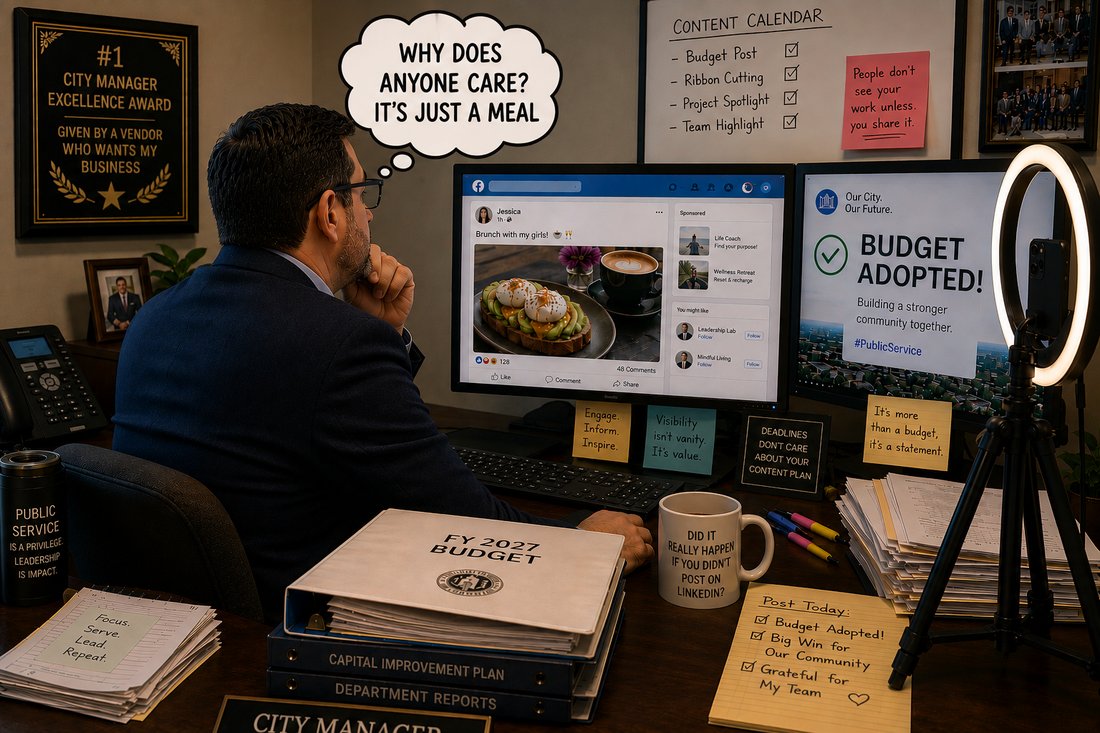
Residents will almost never see this, and if they do, won't care and will likely roll their eyes. Ultimately, it's professionals performing for professionals, refereed by vendors selling products.
I do understand that visibility matters in a profession where careers move between cities and the tenure of a municipal CAO can be shorter than what we'd prefer. Future employers Google candidates and it's nice to have your own voice out there, especially if news articles cast a different light based on past community tensions. And there is value in helping the public understand what government does because many genuinely don't know the full extent.
But there is a difference between explaining the job and performing it. Think about the pilot. They landed the plane; that's their job. They were hired because they could do it, and their silence is part of the reason we believe them.
The Case Against Our Own Mythology
This is a good job. I do it because I enjoy it, despite the difficulties it's presented. But it's not the hardest job on the planet. It is not splitting the atom.
I say this as someone who's been through a lot. I have had hard councils and harder years, and I've been fired along the way. As much as anyone, I know how public the profession's failures are and how private its successes can be. I also understand why it sometimes feels necessary to want the public to see the burdens we sometimes carry because the strain is real. That's precisely why I think the mythology sells us short. It takes a demanding profession and dresses it up in a costume nobody asked for and comes across as asking for sympathy for merely doing the job we signed up for. It's a hard job the same way other leadership jobs are hard. There are competing priorities, public stakes and demanding stakeholders. People who run schools, clinics, farms, or a restaurant that has to make payroll on Friday deal with the same burdens.
I should admit that it took a while for me to arrive at the views I am presenting in this piece. Not because I participated in any of the actions, but because I wanted to see the value in the self-promotion and give the benefit of the doubt to my colleagues who took different approaches than me. When I read Douglas Newman's "Selfie-Less Leadership Development and Self-Reflection" article in the June 2025 edition of PM Magazine alluding to this, I admit, I thought he was being a bit of a curmudgeon. Almost immediately after reading the article and scrolling LinkedIn, I'd see a post bordering on what he called being "self-absorbed." Then, I would go back and re-read his article. I'd do this quite a few times over the next few months.
In between readings, I went back and forth on the self-promotion aspect of the posts. For early career professionals, I saw what they were trying to do and softened a bit. A little visibility is sometimes how people get a fair look. Eventually, however, things changed. After following the local government corner of LinkedIn long enough, I came to realize that Newman wasn't a curmudgeon, he was early and on point. At some point I came to realize that people weren't just sharing work, they were performing it, and the volume knob broke off. His one line that will stand the test of time in this argument is when he says that "the overwhelming majority of us are not operating in a . . . life or death leadership environment" and our own leadership development would benefit from remembering it.
The noble suffering framing isn't just tacky, it's costly. Recruiters and employers will eventually respond to this with a collective eyeroll, possibly hurting future employment prospects. In the event the public starts to see the invisible burden framing, they are going to find it strange that they pay taxes to fill potholes, maintain infrastructure and have responsible budgets; but see us writing essays that treat those same tasks as either life-changing triumphs or crushing burdens, sometimes both in the same week.
We also have a well-known pipeline problem, and I am not convinced that the solution is telling talented graduates that the job is 14 simultaneous crises with no off-switch; or setting them up for disappointment if we pitch the career as a life-altering transformational journey.
There's also what the framing teaches. When "no off-switch" becomes a badge of honor instead of a management failure, we tell rising professionals that exhaustion is the price of admission to the field. It shouldn't be. A well-run organization is one where the manager can take a vacation. A profession that brags about never turning off is advertising that its organizations aren't well run.
None of this is a standard I am inventing. ICMA's Declaration of Ideals has been around for decades. Ideal 8 calls on us to affirm the intrinsic value of public service, meaning the work is the point. We ostensibly entered this field to serve our communities. When colleagues treat routine aspects of the job as transformational moments for public consumption, they are shifting the focus from the work to themselves and signaling that public recognition has become an equal part of the objective.
What Quiet Competence Looks Like
I'm not arguing for silence. There are things worth posting: recognition of staff who never get it, plain-language explanations of how a levy works, a genuine mistake and what it cost. The test is simple: is the post about the work, or is the work about the post?
Before writing this, I audited my own feed, because nobody should throw this particular stone without checking their own glass. Most of what I found was from when I worked for ICMA, promoting the organization, the profession, and other people's efforts. That's the job when you work for a membership association, and it's the easy case: the post is about someone else. But I did find one post, a few years old, announcing a digital transformation project when I was managing another community. It credited the staff member who did the heavy lifting and offered to walk peers through the process, which I'd defend. It also linked to a vendor's case study about my own town and me, which I wouldn't do now. That's the line, and I was standing closer to it than I'd remembered in that one post. The point isn't purity. The point is knowing where the line is.
The best managers are pretty bad at the content game, as they should be. They pass their budgets without commentary, and they get their roads paved without narrative arcs. They own when things go wrong and let others take praise when they go right. They don't need to hear, or give, a LinkedIn version of a TED talk to do their jobs. They let their work do the talking. If you look and listen closely, you will see or hear nothing. It's just an ordinary Tuesday with no clapping.

◆