Right Instinct, Wrong Room
Five hundred Hillsborough residents packed a meeting to express concern with rising property taxes. Showing up was admirable, but they were talking to the one body in the room that has no control over 85% of the bill.
The concern appeared to be genuine. When Alisha Uccardi addressed the Hillsborough Township Committee after organizing 500 people to attend a meeting to express concern about property taxes, it made news. Any coverage of local news these days is a good sign, and regardless of where one stands on any issue, getting back to a day where regular coverage becomes the norm would be a good thing. Property taxes, naturally, were the issue, as one would expect in New Jersey. One by one residents came to the podium to respectfully express concern and offer ideas. The Township Committee seemed to listen. Where it goes from here is anyone's guess.
I've spent almost 15 years helping lead municipal governments in New Jersey as a Town Manager and Administrator. It's a tough profession anywhere, and even more so in New Jersey. That's a story for another day. I've enjoyed the career that's produced some good times and some bad times. Yeah, I've been fired along the way, it happens.
One thing remains constant in this job. Regardless of town, size, demographics, or financial profile, every town in New Jersey faces budget pressures. We all deal with the pressures of providing services at a high level while being constrained by limited revenue sources, various spending caps, public sentiment, and a dwindling number of people interested in public employment.
Right Instinct, Wrong Room
Here's the thing, though. I've had residents fill Council Chambers for all sorts of reasons over the years. What happened in Hillsborough isn't new in that regard. What's somewhat new is that it was over the issue of property taxes. Not because it's an issue people don't care about. By any measure it's the number one issue in the state. Instead, when residents pack council chambers it's usually a more specific issue than general finances. In Hillsborough, it was a result of some community organizing over general tax bills. By way of background, the Q3 tax bill is always higher than the Q1 and Q2 because they are estimated. Q3 comes out after the budget has been passed. So if taxes spike, it's usually first noticeable when the Q3 bill arrives.
Here's the problem. Hillsborough residents attended the wrong meeting. See, while the Township collects the entire bill, nearly 85% of the funds leave the township government and go to other governments and autonomous districts the committee has no authority over, like the school district, county government, fire district, and open space tax. The people they are talking to can only address the 14.89% of the total tax bill that Hillsborough actually keeps.
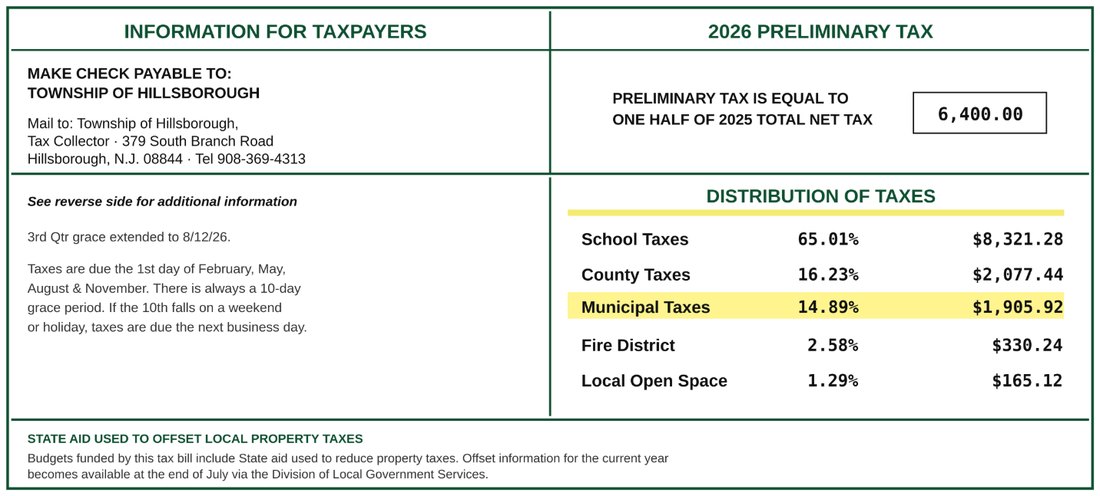
The obvious next question: but it's still a lot of money, right? Hillsborough's operating budget is approximately $43 million and about $30.7 million is collected from property taxes. That's not small. But here's the thing: the average property tax bill in Hillsborough is about $12,800 per year. If the entire cost of the municipal operations magically came down to zero dollars, the average bill would drop by about $1,800 to $10,200. In plainer terms, the average resident is paying about $150 per month to fund the entire municipal government operation.
What You Can't (or Won't) Touch
Even if you wanted to take a shot at lowering the municipal budget to have a meaningful impact, it's admirable. Any operations, public or private, can be analyzed for efficiencies. In the public sector, however, there are political realities and residents' expectations that matter. So let's take a look at the main drivers of that budget. According to Hillsborough's public budgeting portal, public safety makes up 25% of the budget, and that undersells the actual figure. That 25% doesn't include the pension cost of just north of $3 million, health benefits of $918k and payroll taxes of $631,098. So the real percentage of public safety is closer to 35%. Of this, 85% is actual cost of the officers. Very few residents in most suburban communities would stand up at a podium and suggest cutting public safety and reducing the number of their officers. And even fewer elected officials would lead with that.
So what's a town to do when the largest driver of a municipal budget is politically and realistically untouchable?
Add to this, another 15% or so comes from the Public Works budget, and now you have nearly 50% of the budget that most people, residents and elected officials alike, would never agree to cut. Remember the context above when I said the average resident is paying $150 per month to fund the entire municipal government: $75 of that goes to public safety and public works.
The Coverage
This is where Eric Johnson and NJ101.5 come into play. In an attempt to cover an "uprising" among residents, with some questionable 90's nostalgia sprinkled in, there were two stories in 3 days applauding the residents while, with the exception of referencing the CFO's comments about the Township's reassessment process, not pointing out that they were by and large directing their frustrations at the wrong group of people. By all accounts the Committee addressed residents' questions. I've seen this play out many times over the years, in my communities and others I've observed.
The financial breakdown of Hillsborough's budget would be no different than almost any other full-service New Jersey municipality and would only differ by scale. But it's tough to make these arguments because it can come across as dismissive. While there's nothing wrong with Eric and his team covering this story, it could've been better had it included a real breakdown of the budget, what it entails, and how much of the taxes Hillsborough actually controls. And then, directed residents to their school boards and state legislators. Instead, part of what we got were two ideas Eric called worth taking seriously, each built on the same kind of mistake: a number that isn't what people think it is.
The First Idea: Pay Per Student
The first idea, on school taxes, is "tying the cost more directly to how many children a household actually sends to the local school district, arguing the current system asks households with no kids to shoulder the same load as everyone else."
I understand the instinct for someone with no kids to make this argument, but it's virtually impossible to calculate and would fall harder on families with multiple kids, the ones likely feeling the highest burden of the property tax issue. We often hear the cost per pupil number cited in varying contexts, including this one. The problem is that "cost per pupil" is not a true cost. Using simple numbers, let's play this out: if an imaginary school district had 100 kids, and a budget of $1 million, that cost would be $10,000 per pupil. If 10 kids leave the school district tomorrow, could the budget be reduced by $100,000 down to $900,000? No, and that's the fallacy of the per-pupil figure. All 10 kids wouldn't be leaving the same classroom or grade. They would be from various parts of the school. You'd still need the same number of buildings and teachers, utility costs would remain the same, and insurance wouldn't change. The main drivers of the budget remain, and it still costs the same $1,000,000.
The Second Idea: The “Rebate” That's Not a Rebate
Now move to what seems to be his defining proposal, that if the state just listened, we'd be on the journey to lower property taxes. It's titled, "My actual proposal, again." This screams, "why won't anyone listen to me!!!" Well, Eric, maybe because the "proposal" doesn't make any sense.
First, the proposal. He references three programs: Stay NJ, ANCHOR, and Senior Freeze, and calls them "rebates with cute names." He argues that these three programs ask residents to pay the "highest property taxes in the country" and then apply for permission to get some of it back. He suggests we eliminate these programs and just have lower taxes, rather than have people have to apply to get it back.
A proposal like this demonstrates a fundamental misunderstanding of these programs and how they are funded. Stay NJ, ANCHOR and Senior Freeze are funded from state revenue, income and sales tax, not from the municipal levy. The money a resident pays in property taxes goes to the municipality, or other taxing entities like the school district or county. None of the money goes to the state. The only money a resident pays the state is income tax directly, and sales tax, indirectly.
These programs are not, in any sense, "rebates." When people hear rebates, they think about purchasing something and then completing an annoying form, mailing it in, and waiting six weeks for a gift card. That is not what these programs are. They are referred to as property tax relief. This is not me trying to be over nuanced or wonky, it's a reality. No law or rule could simply eliminate these programs and lower tax bills instead, because the two come from completely different pots of money. Put more simply, the state is not handing back money it collected locally and could just as easily have left in your pocket by lowering your bill. It's spending state dollars on targeted relief.
Because of that, it seems futile to even make the next argument on these programs, but I will do so for the sake of understanding. Even if there was some magical way to eliminate these programs and lower tax bills, such a proposal ignores the nature of these programs altogether. These programs are targeted at senior citizens and at those with lower to moderate incomes. If you took that pot of money and spread it across every property owner instead, now it dilutes the breaks for seniors and lower/middle income owners, because now the higher income non-senior with a million-dollar home is getting that relief.
So, we have two proposals, both offered as genuinely interesting. One takes a cost that isn't real. The other redirects money that was never local to begin with. And both, followed to the end, land on seniors, moderate incomes, and families with kids in schools.
So What Now
I've been doing this for a long time. I wish I could write something profound that would make for a great solution to lower property taxes. I can't. My lane is local government. But I know enough to know that if you had this discussion at a school board meeting or county commissioner session with the same set of concerns, you'd get a version of the same answer: most of what is spent is fixed, statutory or politically untouchable. Are there things in any budget that could be trimmed or seen as excessive? Sure. But they never add up to a meaningful number people are hoping for.
This all raises the toughest question of all. Is the real answer just that our tax burden is simply here to stay? Maybe it is. And maybe it's just a function of living in a high cost of living state, where job opportunities are plentiful, and income is higher. New Jersey has 9 million people, wedged in between two of the largest job markets in the country. The same density and location that drive the cost of government also drive the incomes and access. Our public schools rank among the best in the nation, year after year, and 65% of the tax bill is what buys them.
Maybe when we talk about those homes in Florida, Arizona, or other parts of the country where a similar size home comes with what appears to be a dramatically low property tax bill, we need to realize that we give up the sheer number of jobs within reach, the schools that rank among the best, and the other things you probably like about living here. Maybe it just is what it is. But if it can change, it is going to be at the level where the money is actually decided. That's not a township podium, where 500 people, however right they were to show up, were asking the one body in the room that couldn't come close to giving them what they were asking for.
◆