The Case Against the Council-Manager Form Proves It Works
A Des Moines op-ed wanted accountability and reached for a strong mayor. Held up to the light, the argument for abolishing the manager turns out to be an argument for concentrating power.
At some point I was always going to write about the council-manager form of government. The obvious version of that article is a defense of the model in the abstract: the professional management, the insulation from patronage, the ninety-plus years of adoption across most large American cities. It would be correct, and it would be boring, and you would stop reading before the third paragraph. So I'm not going to do that. Instead, from time to time, I'll write about the form where it's being discussed or contested, usually in response to something someone else said or published. When this happens, the argument gets made on the facts of a live case. This article is the first of those.
Des Moines, Iowa is facing a purported $12 million shortfall in its fiscal 2028 general fund. A clarification first: a city doesn't run a deficit like the federal government. It passes a balanced budget by law, and the "shortfall" is the gap between what current services would cost and what current tax rates would raise. The constraints are real; the word oversells them.
Recently, the Des Moines Register ran an op-ed that reached past the financial issues to the city's form of government and argued that Des Moines could close part of the gap and buy itself real accountability by scrapping the city manager and installing a strong mayor. I want to take that argument seriously, because it's made in good faith. I wouldn't necessarily respond to every op-ed or letter to the editor, but this one is worth stopping for because it is wrong in a structural way, not a matter of emphasis or values but of mechanism: it diagnoses a problem and prescribes the cure that deepens it.
Here is the thing about arguments to switch to a strong-mayor form of government: the real reason is almost never the stated one. The real reason is often power, the plain wish for one office to be able to do more than it can do now. But wanting control over staff is not something that plays well in a newspaper, so the case arrives in other clothes: accountability, efficiency, savings, a shortfall that demands bold structural action. Those are the reasons you can actually check, and they are the ones that fall apart under any reasonable analysis.
Budget Issues
Start with the financial challenges, because it's where the argument comes apart first. The op-ed's largest items are straightforward: millions a year to a housing-rehab entity, spending on a downtown revitalization program, fees to out-of-state consultants. Every one of those is a budget line, and budget lines are voted by the council, in public, on the record. They are not things a city manager can authorize alone. They are things seven elected officials chose and can choose differently next cycle, regardless of form of government.
This is the part that never survives contact with how governments actually run. Managers propose; councils appropriate. A manager can recommend a consultant contract and draft a budget, but the dollars that draw the op-ed's fire, like the multi-year engagements and the program lines, are council votes, not administrative signatures.
The crux of the op-ed's complaint is a record of decisions made by elected people who already stand for election. The accountability mechanism the piece says is missing is the one that produced the grievances it cites.
The personnel matters are a different category, and the references in the op-ed make them worth mentioning. A harassment settlement or a hiring dispute can be laid at an administrator's feet in a way a budget vote cannot. That's fair. But it still cuts the wrong way for the argument. A manager who presides over that is an at-will employee the council can remove at will. A strong mayor who presided over the same thing is removable only at the ballot box or costly recall, which could be years away. The one part of the list with a real administrative dimension is the part where the current form holds the executive on the shorter leash, not the longer one.
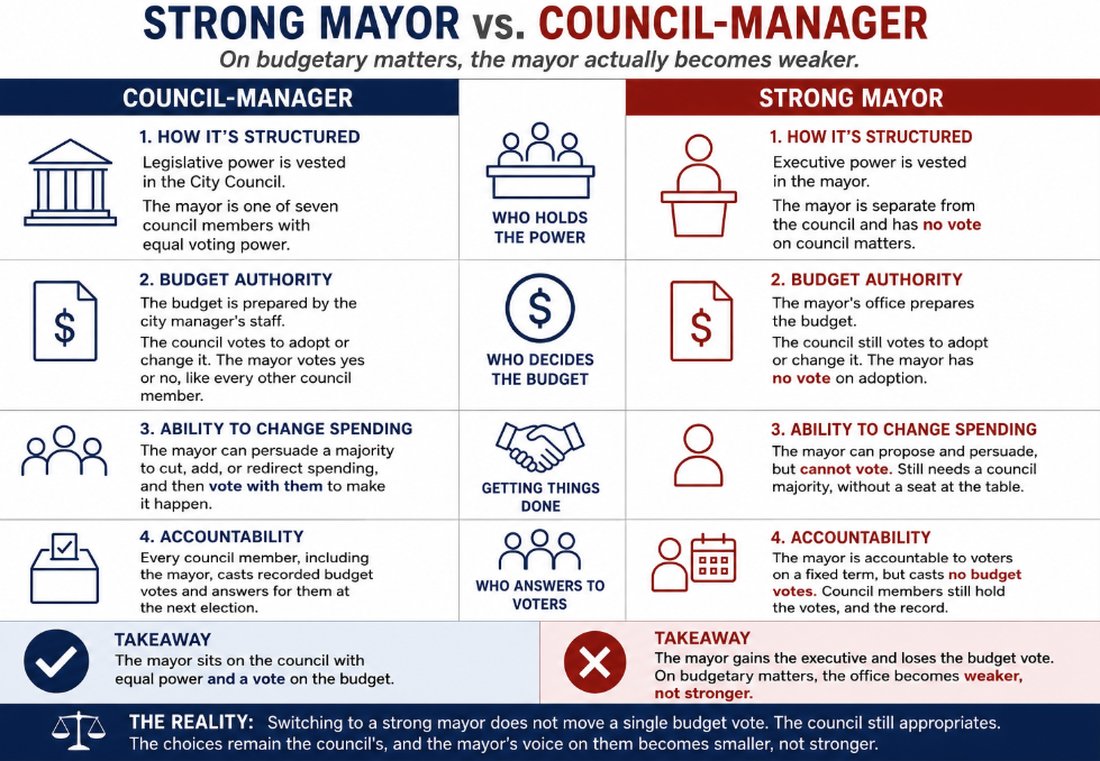
Which means the proposed cure has nothing to reassign. Switching Des Moines from a council-manager to a strong mayor does not move a single one of those votes. The council still appropriates. Even the budget, which a strong mayor would write instead of the manager, still goes to the same council for the same vote. The consultants still get hired, if the council still wants them. You can change the form of government and leave every line item the op-ed is angry about exactly where it was.
Where the Premise Breaks
It gets worse for the argument, because the premise is broken before the remedy arrives.
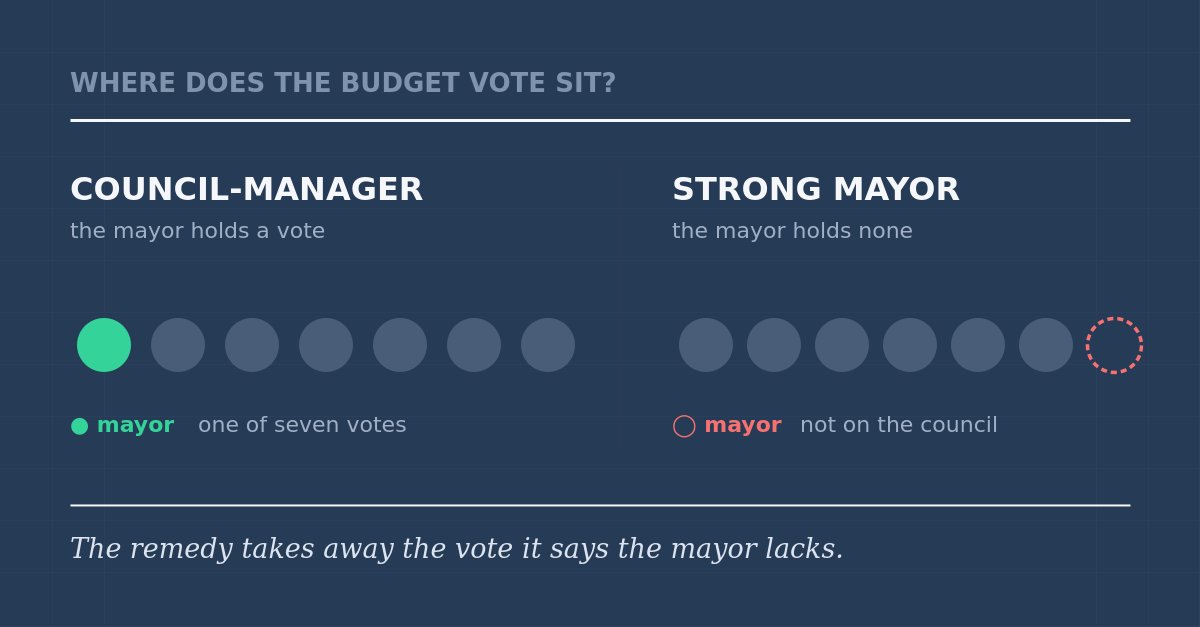
The op-ed calls Mayor Connie Boesen "relatively powerless" and writes that she "effectively holds the same access to deliver change as anyone else on the City Council." O.k., so what's the problem? Want a stop sign, the piece says; she can ask. Want a program expanded; she can ask. The passage is offered as proof of impotence. It's the opposite. Boesen holds the same access as anyone else on the council because she is a voting member of the council, with one of its seven votes. An equal vote is how the office is designed to work. An elected legislator persuading a majority to act is not powerlessness. Instead, it's legislating. The same work every council member and, for that matter, every member of Congress does.
Take his own three examples. A stop sign, a summer food program, a change in housing policy. He offers them as proof of her inability to act: she can only ask. But look at what they are. The food program is a budget line. Housing policy is an ordinance. Even the stop sign is a council matter. Not one of the three is something a mayor delivers alone in any form of government, because all three require a vote of the council under any form of government. And under the strong-mayor structure he is proposing, the mayor is not on the council to cast one. His examples do not show a mayor who lacks power. They show three ordinary legislative decisions that take a majority, which is exactly how it works now and exactly how it would work after.
The form change delivers none of them.
Iowa law makes the distinction concrete. Under the council-manager form Des Moines uses, the mayor sits on the council and votes on everything before it, the budget included. That is the current arrangement. That is Boesen today.
Now put the strong-mayor form beside it. In Iowa's mayor-council structure, the one the op-ed is reaching for, the mayor is not a member of the council and does not vote, with a single narrow exception to break a tie in an even-membered council, and even that carve-out excludes ordinances and resolutions. A strong mayor in Des Moines would have no vote on the budget at all.
Sit with the sequence.
The op-ed says the mayor is powerless, then prescribes the one change that removes the council vote the mayor now holds over the very thing in dispute.
And it does not happen by promotion. Under Iowa law, changing a city's form of government runs entirely through the ballot: a petition of a quarter of the last election's voters, a special election to adopt the new form, and then a regular election to fill the offices the new form creates. Nobody is elevated into the strong-mayor chair. The office is created and contested, and whoever wins it, Boesen included if she runs, takes a seat with no vote on the budget. The remedy runs backwards from the complaint. What a strong mayor gains is not a louder voice in appropriations; it is a quieter one, traded for something else.
What a Strong Mayor Actually Gains
So what is the something else. Here is the quiet part not usually said out loud.
What a strong mayor actually gains is the executive, which usually includes the power to appoint and to fire. They get direct command of the department heads and, through them, the staff. That is the real content of the trade: give up the council vote, take control of the workforce. The appointment power, conspicuously, is the one power the op-ed never asks for. Read it again and you will not find a claim that the manager hired the wrong people, ran a department into the ground, or made an executive call the mayor should have made instead. Every grievance points at the council's votes. Not one points at the manager's administration.
An argument that wanted executive authority would be built on perceived executive failures. This one is built on appropriations, then it reaches for a structure whose distinguishing feature is executive control. The gap between the evidence offered and the remedy proposed is the tell. "The public deserves accountability" is a better sentence to say into a microphone than "I would like personal command of the staff," but the second is what the requested structure delivers. When a mayor runs expecting the city manager to function as a chief of staff, this is the argument that mayor makes: the accountability language on the outside, the appointment power on the inside.
I don't know the writer or his motives, and I'm not assigning one. I'm describing the shape of the argument, which is the same shape whoever makes it. The structure being asked for is an executive structure. The case being made is not an executive case. That mismatch is worth naming plainly, because it is the whole ballgame, and it is usually left unsaid.
Salaries and Money
A word on the money, since the op-ed leads with a dollar figure. The savings claim compares the compensation of the city manager and assistants against what an elected strong mayor and deputy would be paid, and books the difference as a gain to the public. The comparison is a category error. A city manager is an at-will employee the council can dismiss at any meeting, for any reason or none. An elected mayor holds a fixed term and can be removed only at an election, years away. You can't benchmark the salary of an employee you can fire tomorrow against the salary of an official you are stuck with until the next cycle and call the swap a savings. You are buying a different, and looser, accountability arrangement, and paying to do it.
An Interest Worth Naming
One more thing belongs on the table, and I'll put it there the way I'd want my own interests put. The op-ed is written by Chris Draper, identified in his byline as CEO and co-founder of morriganAI, an artificial-intelligence company based in Des Moines. Draper is also a registered lobbyist at the Iowa statehouse, and morriganAI is among his listed clients. That's worth knowing when you reach the line that "AI can deliver gains in organizational management." The argument is, among other things, one made by someone who builds management technology, on behalf of a governance change that concentrates a city's management under a single elected executive. I'm not questioning his sincerity, and I don't need to. The merits fail on their own, which is what the paragraphs above are for. But an interest is an interest, the reader should weigh it, and I'd rather name it plainly than have it noticed later.
Which returns me to why this piece exists in the form it does. You do not defend the council-manager model by praising it. Praise is cheap and, as I said at the top, boring. You defend it by watching what its critics actually ask for when they think they're asking for something else. The Des Moines op-ed wanted accountability and reached for a structure that removes an elected official's vote and hands a single officeholder command of the staff. Held up to the light, the argument for abolishing the manager turns out to be an argument for concentrating power, wearing the clothes of an argument for dispersing it.
That's the case, made on a live one instead of in the abstract. There will be others. The form is contested somewhere new every month, and the contest is always more revealing than the civics lesson.
◆